
How much deep sleep do you need? Normal amounts by age (2026)
How much deep sleep do you need? Most adults get about 10-20% of the night, roughly 1 to 1.5 hours. What's normal by age, after menopause, and how to get more.
Most adults need roughly 10% to 20% of their sleep to be deep sleep, which works out to about 45 to 90 minutes on a 7.5-hour night (the Sleep Foundation's range for 7 to 9 hours of sleep is about 40 to 110 minutes). There is no single "right" number: deep sleep varies from person to person and tends to shrink with age, and how rested you feel in the morning is still the best everyday sign that you are getting enough.
If your Apple Watch shows "only" 40 minutes of deep sleep, don't panic. Below, you will find what deep sleep is, what's normal at your age, why it can change after 40 and in menopause, how far you can trust a watch's estimate, and the handful of habits that genuinely help.
What is deep sleep?
Deep sleep is the third stage of non-REM sleep, also called slow-wave sleep (or N3) because your brain waves become slow and large. Your breathing and heart rate slow down, your muscles relax completely, and it is hard to wake you. If someone does wake you from it, you may feel groggy for a while.
You cycle through sleep stages in loops of about 90 to 120 minutes, four or five times a night. Each loop includes light sleep, deep sleep and REM sleep (the dreaming stage), but the mix changes as the night goes on: deep sleep is concentrated in the first half of the night, while REM and light sleep dominate the second half. That is one reason the early morning is when people wake up most easily (see why you wake up at 3 AM).
Why deep sleep matters
According to the Sleep Foundation's review of the research, deep sleep is linked to:
- Physical repair: growth hormone is released and tissues, muscle and bone recover.
- Immune health: sleep supports immune responses and lower inflammation.
- Blood sugar and blood pressure: short deep sleep is associated with a higher risk of type 2 diabetes and high blood pressure.
- Memory and thinking: the brain appears to consolidate what you learned during the day.
- Brain "housekeeping": deep sleep may help clear waste products from the brain.
These are associations from studies, not a sign that a single short night harms you. Researchers have also observed that extra deep sleep can be the body's way of recovering from lost or broken sleep.
How much deep sleep is normal?
| Total sleep | Typical deep sleep (10% to 20%) |
|---|---|
| 6 hours | about 36 to 72 minutes |
| 7 hours | about 42 to 84 minutes |
| 8 hours | about 48 to 96 minutes |
| 9 hours | about 54 to 108 minutes |
The Sleep Foundation puts typical adult deep sleep at 10% to 20% of total sleep time. Lab studies that wire people up with full sleep recordings sometimes report a bit more in young, healthy adults, as you will see in the table below. The point is not to hit an exact figure: a night at 12% is not "bad" and a night at 22% is not "better."
Deep sleep by age: what research shows
Deep sleep is highest in childhood and the teen years, then changes gradually through adulthood. Here is what large studies found:
| Age | What the research shows |
|---|---|
| Children and teens | The most deep sleep of any age; it falls steadily through adolescence (Ohayon, 2004). |
| Early 20s | About 24% of the night, roughly 87 minutes, in a large population study in São Paulo (Pires, 2021). |
| 20s to about 60 | Deep sleep's share of the night falls by roughly 2% per decade on average (Ohayon, 2004). |
| Women 37 and older | Women had, on average, about twice as much deep sleep as men, and showed no consistent age-related decline, unlike men (Redline, 2004). |
| After about 60 | Studies of older adults only found little further change in deep sleep share (Ohayon, 2004). |
| Late 70s | About 18% of the night, roughly 53 minutes, in the same São Paulo study, partly because total sleep gets shorter (Pires, 2021). |
Two things stand out for women over 40. First, the decline in deep sleep with age is mostly a male story: in the Sleep Heart Health Study of more than 2,600 adults aged 37 to 92, men's sleep got lighter with age while women's did not follow a consistent pattern. Second, much of the change people notice in midlife is not about deep sleep at all, but about waking up more often in the second half of the night.
Why deep sleep can change after 40 and in menopause
You might expect menopause to wipe out deep sleep. The research is more surprising. A review in Sleep Medicine Clinics found that sleep-lab studies do not consistently show less deep sleep in perimenopausal or postmenopausal women, and a few even found more. The researchers suggest that extra deep sleep could be the body compensating for broken sleep.
What does change, very clearly, is how often you wake up:
- Hot flashes and night sweats pull you out of sleep. Women with moderate to severe hot flashes were almost three times as likely to report frequent night wakings.
- Sleep apnea becomes more common after menopause, and repeated breathing pauses fragment sleep, including deep sleep.
- Mood changes and stress can make it harder to fall and stay asleep.
So if your nights feel worse than they used to, the first suspect is usually broken sleep, not a lack of deep sleep. Our guide to perimenopause sleep problems covers what helps.
How the Apple Watch estimates deep sleep (and its limits)
The Apple Watch can't read your brain waves, which is what a sleep lab uses to measure deep sleep. Instead, it estimates your sleep stages from what its sensors pick up at your wrist, and shows them in the Health app as Awake, REM, Core (light sleep) and Deep. Here is how to turn tracking on and find your stages.
How close is it? In a 2024 study at Brigham and Women's Hospital, 35 healthy adults aged 20 to 50 slept one night in a lab while wearing an Apple Watch Series 8 (along with other trackers), and the results were compared with a full sleep recording:
- The watch was very good at telling sleep from wake, catching 97% of sleep.
- It was much less precise for deep sleep, recognizing about half of the deep sleep the lab recorded.
- On average, it underestimated deep sleep by about 43 minutes and overestimated light sleep by about 45 minutes.
The study was small, lasted one night, included only healthy adults under 50, and was funded by a competitor (Oura), so treat the numbers as a guide, not a verdict. The practical lesson: a watch is better at showing your trend over weeks than the exact minutes on one night. If your watch says 35 minutes, your real deep sleep may well be higher. The same caution applies to scores built on these estimates, such as Apple's sleep score.
How to get more deep sleep (what the evidence supports)
There is no supplement or gadget proven to "boost" deep sleep in healthy adults. What helps is giving your body the conditions to produce it on its own:
- Protect your total sleep time. Deep sleep comes early in the night, so it is the stage you are least likely to lose, but a short night still means fewer cycles. Aim for 7 hours or more.
- Keep a regular schedule. Going to bed and getting up at consistent times is the Sleep Foundation's first tip for better deep sleep.
- Keep the bedroom cool, dark and quiet. Your body needs to cool down to sleep deeply.
- Go easy on alcohol, especially late. Alcohol is another substance that can change your sleep pattern, and it tends to break up the second half of the night (more in why you wake up at 3 AM).
- Cut caffeine in the afternoon and evening. The Sleep Foundation lists caffeine among the substances that can alter deep sleep.
- Stay active during the day. A large review of 66 studies found that a session of exercise had a small positive effect on deep sleep, and regular exercise improved total sleep time and sleep quality.
- Try a warm bath or shower before bed. The Sleep Foundation notes it may increase slow-wave sleep, though evidence is limited.
- Treat what breaks your sleep. If hot flashes, snoring or sleep apnea wake you up, treating them protects deep sleep more than any habit can.
Track your trend, not one night
Watching deep sleep is most useful over a week or a month. Sleepwrist reads the sleep your Apple Watch already records in Apple Health and shows deep sleep as a share of your night, with trends over 7 or 30 nights next to time asleep, wake-ups and heart rate. Its sleep score (0 to 100, told in words first: Optimal, Good, Fair, Poor) counts deep sleep as one ingredient among several, alongside time asleep, REM sleep, efficiency and wake-ups per hour.
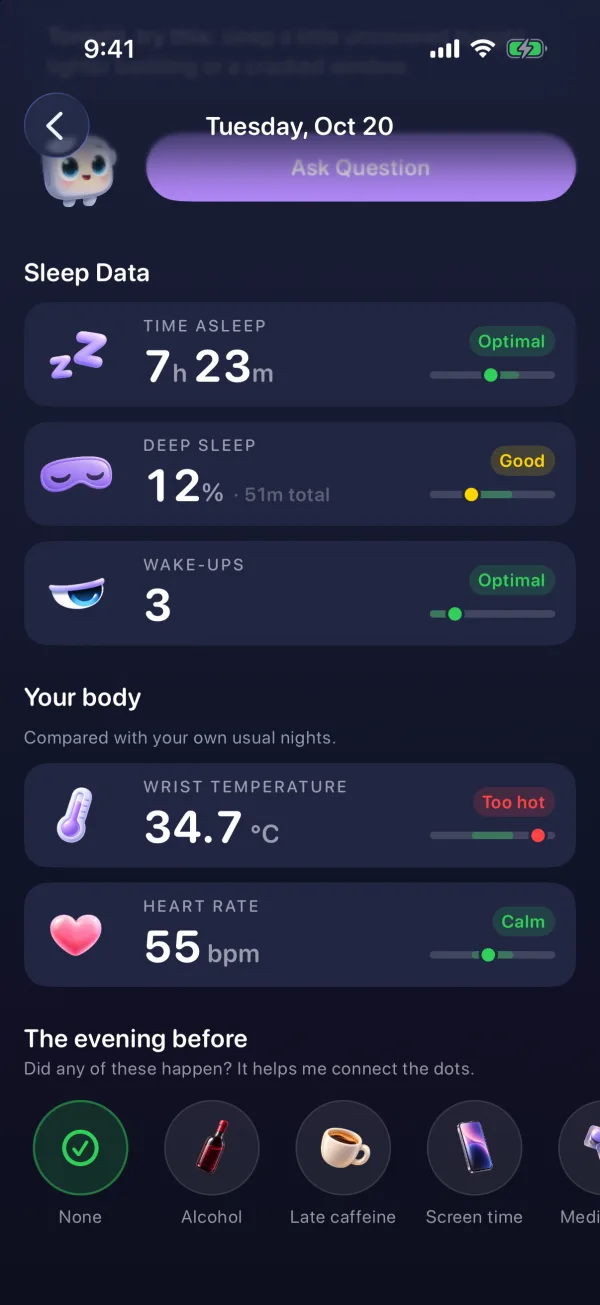
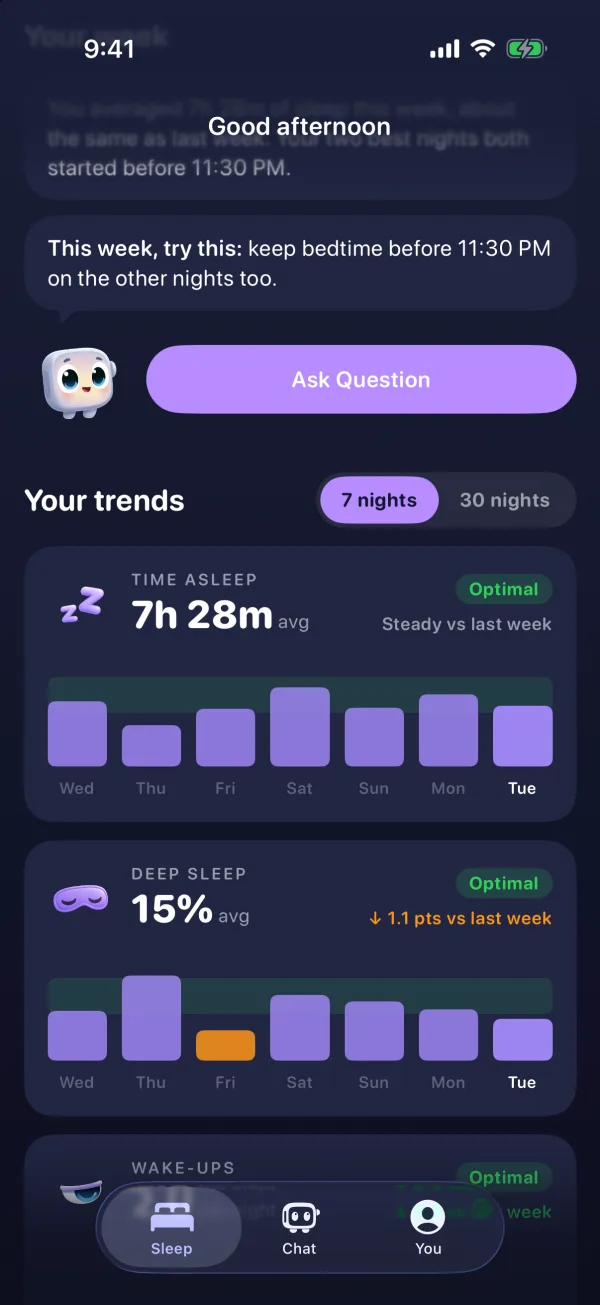
When your deep sleep runs low, Wristy, the app's friendly watch mascot, says so in plain words and suggests one simple thing to try tonight. And because feeling rested matters as much as any number, a quick daily mood check-in lets you compare how you feel with what the watch measured. Sleepwrist is a wellness app, not a medical device.
When to talk to a doctor
Low deep sleep on a tracker alone is not a reason to worry. Do talk to your doctor if you feel unrefreshed most mornings despite enough time in bed, if you snore or someone notices you stop breathing at night, if you wake many times a night for weeks, or if hot flashes are disrupting your sleep.
Frequently asked questions
How much deep sleep do you need at 50?
There is no official target by age. Research suggests deep sleep often makes up somewhere around 10% to 20% of the night for adults, and studies found that women tend to keep their deep sleep better with age than men do. If you wake up feeling reasonably rested, you are probably getting enough.
Is 30 minutes of deep sleep enough?
It is on the low side of typical, but a single night means little, and the Apple Watch tends to underestimate deep sleep compared with lab tests. Look at your average over a few weeks and how you feel. If you are consistently exhausted, talk to your doctor.
Is 2 hours of deep sleep too much?
Not usually. Extra deep sleep can show up after a short or broken night, as a way of recovering. It can also reflect tracker error. It isn't something to fix on its own.
What percentage of sleep should be deep sleep?
Commonly cited ranges are about 10% to 20% of total sleep for adults, with young adults often a bit higher in lab studies. Your own steady average matters more than any single percentage.
Does menopause reduce deep sleep?
Not consistently, according to sleep-lab research. What menopause clearly does is increase night wakings, often from hot flashes, night sweats or a higher risk of sleep apnea. Treating those is usually the best way to sleep more deeply.
How accurate is Apple Watch deep sleep?
It is better at telling sleep from wake than at measuring deep sleep minute by minute. In one 2024 lab study, the Series 8 underestimated deep sleep by about 43 minutes on average. Use it to follow trends rather than to judge one night.
Sources
- Sleep Foundation, How Much Deep Sleep Do You Need?
- Ohayon et al. (2004), Meta-analysis of quantitative sleep parameters from childhood to old age, Sleep
- Redline et al. (2004), The Effects of Age, Sex, Ethnicity, and Sleep-Disordered Breathing on Sleep Architecture, Archives of Internal Medicine
- Pires et al. (2021), Sleep in Older Adults and Its Possible Relations With COVID-19, Frontiers in Aging Neuroscience
- Baker et al. (2018), Sleep and Sleep Disorders in the Menopausal Transition, Sleep Medicine Clinics
- Robbins et al. (2024), Accuracy of Three Commercial Wearable Devices for Sleep Tracking in Healthy Adults, Sensors
- Kredlow et al. (2015), The effects of physical activity on sleep: a meta-analytic review
This article is for general information and does not replace advice from your doctor. If your sleep problems last more than a few weeks or come with other symptoms, talk to a healthcare professional.